
Whitewater Kayaking in Europe vs the US, with McKenley Newman
9-minute read
Aqua Bound Ambassador McKenley Newman grew up in the US but has lived in Europe for the last 10 years. He has extensive whitewater kayaking experience on both continents, which has given him an insider’s perspective on their similarities and differences.

Currently residing in Germany, McKenley has guided and instructed professionally, competed in extreme races, and kayaked all over the world. He’s also a scholar, researcher and publisher in the paddling industry. Additionally, he consults with outdoor companies and athletes to help them succeed with their marketing pursuits.
We sat down with McKenley for a video call recently to hear his perspective on how the paddling cultures of the US and EU compare.
Here’s our conversation with McKenley:
AQUA BOUND: In your experience, how is the whitewater culture different between America and Europe?
MCKENLEY: I’ve been blessed to paddle all over the world, and realistically, the paddle community is very similar no matter where you go. They have a passion for paddling, and they want to paddle as much as possible. Having said that, there are four main differences as far as Europe and the US specifically.
Getting Into the Sport
The first is how you get into the sport and really learn. Europe has a very strong club system, and a lot of these people start very young with these clubs. When you join a club, depending on your country, you’re covered by some insurance as well, which is quite wild.
Also in these clubs, beginners have mentors—people who have paddled forever and know the area rivers to take you down. Additionally, the clubs have gear, so you don’t have this big upfront cost of having to buy your own boat or paddle, especially when you don’t know anything about the sport.

They very much prioritize safety and learn the fundamentals from the beginning, and so have a much, much stronger foundation with this club system.
But some aspects make it a bit more difficult. One is that a lot of clubs don’t paddle beyond Class 3. Once you want to start running something more difficult, you have to form your own independent community. And because everybody’s associated with a club, it’s a lot harder to find people to paddle with.
America doesn’t have that strong club system, so there are negatives at the very beginning. One is that you have to buy a bunch of gear you’re not familiar with. Two, is you don’t have mentors who are giving you that strong, fundamental background.
You can always tell someone who trained at the beginning in Europe versus those in America who’ve taught themselves. Most Americans don’t have that foundation, and it’s a degree that’s less safe because they don’t know the rivers they’re getting on.
That being said, once you’re into the sport and you’ve developed the skills and are ready to be on rivers, I find it’s much easier in the independent community of America to find people to paddle with and to paddle strange rivers. Paddlers aren’t associated with clubs, so everybody is looking for others to paddle with.
The River Systems
Another big difference between the two continents is the river systems. In America, the longer you paddle, the more you realize—at least with the people I’m around—your heart desires to go on multi-days. This is the ultimate love for whitewater. Everybody wants to go on the Salmon or the Grand for all these famous multi-day trips. That’s like the pinnacle in the US.
Well, Europe doesn’t have the river systems for that. There are really only one or two overnight whitewater rivers in Europe. So this isn’t something a lot of boaters work towards unless they’re flying out to a different country. In Europe, everything is a day run.

However, in Europe, the roads always line up with the rivers, which gives us much easier river access. We have access to buses and trains on most of our rivers. In the US, there are more wild, free rivers, but it could take two days to drive there. You have to set up your own shuttles to get multi-days.
So the river systems really dictate how your paddling community plans their trips and what style of boats they have.
Space and Transportation Differences
The last two main differences are ones most people don’t consider, but I find quite fascinating. The first is space.
Generally, Americans have access to big garages so they can have four or five different boats. I know people with seven boats, so they have a garage full of boats to choose from. You have a thousand gear items to do a thousand different things.
Europeans live around a lot more people with smaller storage spaces. Cars aren’t as big. You either have your boat at the club or use a club boat. You may have a max of two boats, but generally one boat that you can do the majority of your rivers on.
The last thing is transportation. In the US, the majority of people own a car. There isn’t the bus and train system that Europe has. In Europe, your club usually has a car with a trailer and does the shuttling.
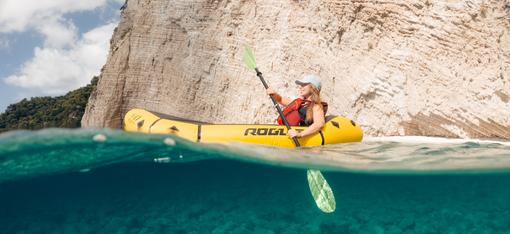
I know a bunch of people who are paddling here who don’t have cars and don’t want cars. Instead, they’ve shifted over to packrafting because they can jump on a bus or a train, get to the river and paddle down, jump on another bus, and head back up to where they want to start. That’s brought packrafting up to a degree you don’t see in the US.

Again though, these are all just external differences. Internally, everyone’s the same, whether they’re from the US, Europe or Asia. They want to paddle as much as possible.
AQUA BOUND: What are your top 3 suggestions for rivers in Europe for Class 1-3 kayakers?
MCKENLEY: I have two suggestions for those just beginning or with a couple of seasons under their belt. The first is the Soča (pronounced Socha) in Slovenia. It’s the most famous and one of the best rivers you can progress on. It has multiple sections so you can bite off as much as you need without getting into too much whitewater.
While learning the first few years, the Soča could not be better, which is why it’s probably the most famous river in all of Europe. It’s great for beginners if you have a basic level of skill where you can catch some eddies and ferries. You don’t even have to be an intermediate.
And then I always suggest the Durance Valley in France. This is like the Soča, where you can choose where you want to be, but there are more options and more advanced options as well. It’s the Soča on steroids, with some of the most beautiful valleys to paddle through.
I love the Durance River and always send people that way. It’s got a healthy progression and a good kayak community.

Last is an unexpected answer, especially if you’re coming from America: the slalom canals. In Europe, there are so many local slalom canals to go train on. Many little towns—especially if you’re in Czech, France, Germany, Austria, Italy—there are small canals created for whitewater. So if you’re not able to make it to Slovenia, which could be a day’s drive or two getting through the mountain passes, you can focus on the slalom canals that are everywhere and progress quickly.
You just pop on there on a Saturday morning and hone your skills, up to Class 3. You can practice the fundamentals with great features without running shuttles or the logistics or a river.
So, the Soča, the Durance Valley and the hundreds of slalom canals across Europe.
AQUA BOUND: Are there outfitters and guides on these rivers?
MCKENLEY: Yes, at least a dozen, plus kayaking schools. Other than the Sjoa River in Norway, the Soča is probably the center for paddling tourism in all of Europe. There are tons of options there. Because Slovenia doesn’t have as much of a train system, accessibility is a little harder. You can fly into the capital (Ljubljana) and then it’s two hours by bus. One person I knew even bicycled there.

Durance Valley is just as big with rafting, kayak schools, kayak shops, and it’s very accessible. You can fly into Paris and take a train directly to Durance, walk off the train station and be on the river near outfitters. And there are campsites on the river where you can stay, if you want to.
AQUA BOUND: What else do you want our readers to know?
MCKENLEY: For North Americans who want to paddle in Europe, find people here and just talk to them directly. The community here is absolutely wonderful and they will give you as much information as you want on any area.
It can be hard coming from North America because Europe is a bunch of different countries with different languages and systems. So the best way is to contact the paddling community. They’ll take care of you.
For Europeans, it’s the same. Find a few paddlers in North America who are reputable and at a good scale level and reach out to them. They’re going to take care of you, tell you exactly where to go and who to contact.
This is one of the most overlooked things when planning trips to both America and Europe: Start with the kayak community and get local advice. Use the internet and use that community
The only thing separating these communities is that big ocean. Both sides love to help out if you reach out.

McKenley Newman, Aqua Bound Ambassador and whitewater kayaker and packrafter
All photos courtesy of McKenley Newman. You can learn more about him on his website: McKenleyNewman.com. He's also on Instagram.
What paddling questions can our friendly Customer Service team help you with? Contact us at 715-755-3405 or sales@aquabound.com, or choose our online chat option.
More for you...