
The Collegiate Whitewater Festival Gives Students Opportunity to Network & Race
10-minute read
The Collegiate Whitewater Festival (CWF) is a unique opportunity for student whitewater kayakers to gain racing experience in a supportive and safe environment.

The Festival was founded in 2015 by leaders in the University of Puget Sound Kayak Club, and has grown ever since (with a couple of challenging years during the COVID era). The 2026 CWF will take place on April 4th with almost 200 racers, volunteers and spectators from the Pacific Northwest and beyond.
This Festival is special for a couple of reasons. First, it’s only open to students (K-12 and college students), and it strives to give access to paddlers of different skill levels by offering both intermediate and advanced races. Second, racers and volunteers can participate for free because of the generosity of donors and sponsors.
Aqua Bound is excited to be one of the Festival’s sponsors for 2026. To let you know more about it, we sat down with Clay Ross, CWF’s lead organizer, to get the details.
Here’s our interview with Clay:
AQUA BOUND: First, tell us about your own paddling background.
CLAY: I got into boating when I was 16 years old. A former teacher was going to a local college's pool sessions and invited me. I was hooked instantly.
For me, it’s as much the community as it is the action of the sport. One of my best friends says the best thing about [whitewater] kayaking is that it’s an “individual team sport.” Everybody’s in their own boat, but everybody is very—I mean, literally—in somebody else’s hands. If something happens, you're counting on everybody else to take care of you.
AQUA BOUND: How did the Collegiate Whitewater Festival begin?
CLAY: I found that in the college club setup, there's almost an expectation of community because you're part of a school, and the school's job is to take care of kids. But out in the real world, that's harder to find. Typically, those clubs tend to be pretty isolated.
I came to the University of Puget Sound (UPS) as a student and was part of our club here. After I graduated, I stayed and became the coach. In my first year as a coach, that exact problem came up. I had a crew of five or six kids at this club with me, and we didn't know anybody else. The club president and the vice president wanted to have some way to get kayakers together and show students they weren’t the only ones doing this.

Clay Ross, coach for the University of Puget Sound’s kayak club and CWF organizer
In these clubs, it's such a small bubble—you have your crew, but you don't get to learn from other people. The Collegiate Whitewater Fest was formed by students to create a space for people to come together. It started as a UPS thing, then as it got bigger, we separated the university from the event, and it became the Collegiate Whitewater Festival.
AQUA BOUND: What are some of the benefits of involving young people in whitewater kayaking?
CLAY: The easy answer is it's just like any sport. Being a member of a community is important. Humans need human interaction, and having a team means a lot. In the whitewater world, we take all of the traditional stuff of teamwork and team building, and then we add things like being out in the middle of nowhere. We can go to places that nobody else can go. I don't get that when I play football.
We also have this element of “moving risk.” Whitewater in general is not a stable environment. It's constantly changing. While that increases the risk available, it also creates an environment where everybody is way more dialed in.
When I played football, if I was off the line, I was cheering, but I didn't need to be a hundred percent in. But when we kayak, if a student is doing a peel-out or an eddy turn, everybody on the crew is watching. If they flip over, people are immediately moving. Whether they need help or not, people are already on their way.
I’ve never seen that level of camaraderie and teamwork in any other activity—this immediate focus on always paying attention and having eyes on each other. When good things happen, everybody celebrates, and when bad things happen, everybody is dialed in and ready to jump in.

AQUA BOUND: What things prevent kids from getting into this sport, and how does the CWF help?
CLAY: The biggest obstacle for most people to get into the sport is access to gear. At my university, we provide all the gear as long as you're a student. That means you have four years to get your own personal kit together, which gives people more time to slowly add pieces.
That’s a part of why we make such a big deal about the prize part of the Festival. Most events I've been to, if there are a hundred people, maybe 20 people get prizes. At the CWF, the rule is that every single racer and every single volunteer walks away with something nice. Whether it's straps from NRS, a breakdown paddle from Aqua Bound, or a dry top from IR, everybody’s getting something.
We prioritize winners, so the first-place finishers in all categories get first dibs. They walk into the prize booth first and pick whatever they want. Once the 1st, 2nd and 3rd place finishers get dibs, we pull every other racer and volunteer name from a hat so they can each enter the prize booth to get gear they need.
Last year, one of the seniors in our club had everything but a boat, and she couldn’t afford a boat because they’re so expensive. Another club had donated a Piranha boat because they didn't need it. She got first place in the intermediate race—which is a Class II-III race—and now she has a brand new boat.

CWF medal winner!
I love that a first-place intermediate—somebody who has been in boating for only a few months but is really working at it—can compete and win something worthwhile like a boat. Out here, you don't see a lot of Class II-III races. Most are for experts.
AQUA BOUND: How does the CWF’s competitive environment help these students build their skills?
CLAY: Racing is scary because for a lot of it, you’re by yourself. Our race has an insane amount of safety—for the intermediate race, every single advanced racer is a safety boater. We have five to 10 people at every single rapid setting safety. But especially in the spaces between rapids, you’re by yourself. It’s pretty disconcerting. You’re used to having people all around you, and all of a sudden, it’s just you.
There’s nobody giving you a line, nobody to follow, and nobody telling you to turn left or go around that hole. It takes away the “perceived support” but keeps the “actual support.” We talk all the time about perceived risk and actual risk. It’s okay to really increase the perceived risk but mitigate the actual risk.
Over 90% of our intermediate racers have never raced before. This is their first time paddling alone. We do offer a "security blanket"—if someone is nervous, we’ll give them a volunteer safety boater or an advanced racer to shadow them. But afterward, a lot of my students talk about how they suddenly want to lead. They’re so used to following adults and being given lines, but now they have this feeling of, "I did all that by myself. I can lead the group on this rapid.”
AQUA BOUND: Tell us about the race course and logistics.
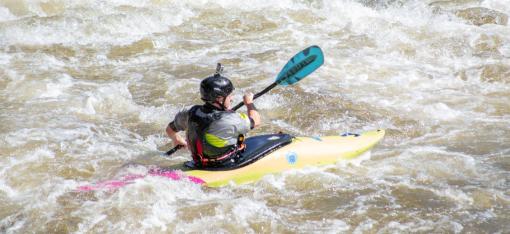
CLAY: We run time trials on the Skykomish River. The intermediate race is about a mile long. Their finish line is perfectly set up to also be the starting line for the advanced race, which goes a mile from there. It sets it up so that all the advanced racers see the intermediates race, and then when the intermediates finish, they get out, leave their boats, and walk down to watch the advanced racers run Boulder Drop, which is the biggest rapid of the advanced race.

We set it up so the hardest rapids on both runs are at the beginning. We did that intentionally. It makes for less of a show, maybe, because people aren't tired running the hardest rapid, but it sets people up more for success. Get through that first rapid and now just get to work paddling.
We send people off every 60 seconds. We have a crew of timers at the start and end with clipboards, and then we run the results through Excel.
We also have incentives: if someone swims and you rescue them, you automatically get an extra prize ticket or the chance to race again. And every safety member who rescues a swimmer gets an extra prize.
AQUA BOUND: What are the Festival’s main goals?
CLAY: In a word: Networking. The connections these students are making between each other are the really powerful part. For example, we're planning to go down to Bend, Oregon, and paddle with the OSU Cascades University Club because of the connections we made with them at the CWF. That’s the dream.
We also started “Vendor Row.” We have businesses that want to sell or demo gear, and companies that want to hire. Raft companies are looking for people, and college kids are really good summer employees. We have organizations like Paddle Trails of Washington State and even a new app for tracking river flows.
It’s all designed to give students a foot in the door. The whitewater community is welcoming, but it’s small. And it’s not just what you know, it’s who you know. We’re introducing these students to people who might be their way in, whether it’s somebody to paddle with or a job. One of my students who graduated last year got a job as a sea kayak guide because of people she met at the Festival.

AQUA BOUND: How common are kayak clubs in the Pacific Northwest?
CLAY: At last year’s CWF, we had over 20 schools, and maybe 15 of those were colleges. Most K-12 schools don't have clubs. In the university world, it’s hard because it takes two to four years to get good enough to teach someone else, but students are only there for four years. The turnover is hard.
At UPS, we’re lucky to have a coach position. If we didn't have that, our club would have died during COVID because the seniors weren't teaching new boaters for two years. Other schools, like the University of Washington, used to have a huge organization, but it died over time. (Our race route is actually modeled after their old race, the “Dog Paddle.”)
One thing we hope comes out of this is maintaining contact. We’ve had students come out all by themselves, and we help them create a club at their school. The University of Idaho is a good example. They never had more than one person come, but one of my student volunteers sent them an Instagram message, and now they’re bringing a whole team this year.
AQUA BOUND: What’s your advice for getting young people into kayaking as a lifetime sport?
CLAY: There are two huge obstacles: gear and support systems. If you don't have a club, it can be very hard to get in. I was lucky because a middle school computer science teacher took me under his wing.
I’ve heard about a “gear library” in White Salmon [Washington]—I think that’s a really good way to provide access. And pool sessions are one of my favorite things because a pool is a safe space and an easy access point.
If your readers are already in the community, they should be conscious about the events they put on and find ways to open them up. When we advertise, we literally search Instagram for outdoor leadership programs at universities and just send them a message: “Hey, if you have any boaters, we’d love to talk to them.” Oftentimes, all they need is that connection to the resources.
* * * * *
To learn more about the Collegiate Whitewater Festival—especially to volunteer or watch—go to their website at www.collegiatewhitewater.com. You’ll find all the details you need to know there. You can also follow CWF on Instagram.
We wish them all the best for this year’s Festival and on into the future as Clay and others continue to teach and expand the wonderful world of whitewater kayaking!

Clay Ross
Photos and video courtesy of the Collegiate Whitewater Festival and Clay Ross.
What paddling questions can our friendly Customer Service team help you with? Contact us at 715-755-3405 or sales@aquabound.com, or choose our online chat option.
More for you...