
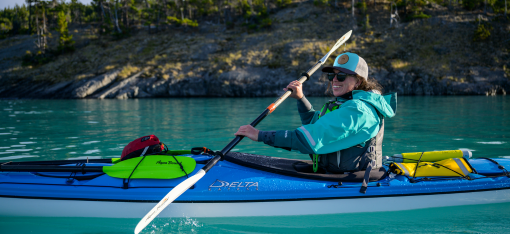
How Do You “Edge” Your Kayak?
5-minute read + 8-minute video
There are eight points of contact in your recreational or sea kayak that you’ll want to engage to be able to “edge” your kayak effectively for better control and maneuverability.
In the video below, Happy Paddlin’s Ethan Ebersold discusses where these points of contact are and how to use them for proper edging:
To new paddlers, a kayak often feels tippy. Like it would capsize easily. But when you learn about how the points of contact between your body and the boat help you control and stabilize it, you’ll enjoy the way it moves on the water.
8 Points of Contact in Your Kayak
There are eight places where your body should be in direct contact with your kayak for the best control:
- Both your feet on the foot pegs
- Both your thighs against the thigh hooks or the padding near the cockpit
- Both sides of your hips along the sides
- Your lower back on the seat backrest
- Your rear firmly on the seat
“All of these [points of contact] are really interacting to let me ‘wear’ this boat,” says Ethan.
NOTE: Very wide, low-budget rec kayaks may not have foot pegs or thigh rests. You won’t feel “part of the boat” like you would in a higher-quality boat. So edging isn’t really possible. The discussion here assumes kayaks with these features.
Stiff vs Loose Body
It’s normal for new kayakers to stiffen their body in the boat in an effort to keep the keel flat on the water. Instead, you want to loosen up so your hips move independently from your upper torso, moving with the boat on the water.
A great way to start to get the feel of that is to sit in your kayak and allow it to rock side to side. Eventually, you’ll want to be able to keep your head and shoulders straight while your hips rock with the boat. “Nose over belly button.”
You’ll find that you can use your thighs and the weight in your hips and rear to keep your kayak tilted on one edge or the other and still feel stable.
To edge your kayak to the right, you’ll lift up with your left thigh at that point of contact while you press down with your right thigh and rear. Vice versa to edge your boat to the left.
Ethan likes to describe it as having a swivel at your hips. Your lower body moves with the kayak while your upper body acts as a plumb line, keeping centered.

How to Get to Know Your Boat’s Edge
Ethen recommends you start next to the dock. That way, you can practice sitting upright while letting your hips move the kayak back and forth. If you feel unsteady, the dock is right there to grab onto.
Again, the key is not to lean your body with your kayak, but to keep your upper body over the seat while your lower body handles the movement.
Practice seeing how far you can edge your boat to one side and still feel comfortable. The dock is there to help keep you from capsizing if you need it. It’s also an aide to practice righting your boat if it’s tipping too much—lead with your hips first, rather than leading with your head.
Use Your Paddle to Help You Edge Your Kayak
You’ll want to master two types of brace strokes to help you edge while preventing a capsize. Your paddle is your tool.
The low brace uses the back face of the paddle. Your paddle is quite horizontal as you use it to push down slightly on the water’s surface on the side where you’re over-leaning to help you right your boat with your paddle and hips, followed by your head. With the low brace, your hands hold the paddle on the top of the shaft.
With the high brace, you use the front face of the blade on the opposite side of your lean. From a vertical position, holding the shaft more underneath, you use the front face of the blade and pull it toward you in the water. This will help correct the over-lean on the other side.

The way Ethan suggests practicing the low brace is by paddling backwards using the back face of the blades. Lean into each backstroke and that will give you the same feeling as the low brace.
Practice the high brace in the same way. Paddle with the power face of the blades turned slightly into the water. As you edge, use your blade to push you upright with a sweep stroke while you snap your hips, followed by your head.
The essence of these strokes is that you rotate your wrists to rotate the face of your paddle blades. You’re using it as a sort of kickstand on the water.
Remember to keep your head and upper body as that plumb line—nice and straight—while your lower body moves with and controls the kayak.
The more you practice this on a calm, warm day on flatwater, the more comfortable you’ll be with your kayak and your strokes.
Photos courtesy of PaddleTV
What paddling questions can our friendly Customer Service team help you with? Contact us at 715-755-3405 or sales@aquabound.com, or choose our online chat option.
More for you...