
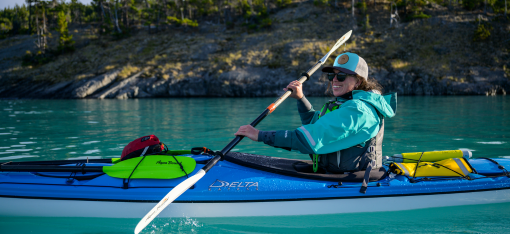
Enhancing Your Kayak Trips with Incredible Food, with Ella Vallance
10-minute read
Aqua Bound Ambassador Ella Vallance grew up working in her family’s sea kayak business in British Columbia, Canada. She loves making sure their guests get to eat incredible food on their kayak trips.

The food on a kayak trip is usually very memorable—for better or for worse! We recently had the chance to sit down with Ella over Zoom to ask her about how they do trip food for the guests of Powell River Sea Kayak.
Here’s our conversation with Ella:
AQUA BOUND: Before we jump into trip food, tell us a little about your kayaking background.
ELLA: After spending more time seated in the center hatch of a Passat G3 than running around the playground like most kids my age, I realized how much I hated kayaking. All those years being hauled around on family paddling trips and washing dozens of boats for my parents’ business, Powell River Sea Kayak, made me detest the floating prison-like bathtubs that lined our front yard.
Fast forward many years later, at the age of 25, I now could not be more excited every spring to begin preparations for the kayak season ahead—both for personal trips and running our business. As a certified Assistant Overnight Sea Kayak Guide and experienced coastal paddler, there’s nothing I love more than sharing this lesser-known world of on-water travel with other adventurers!
AB: Why is food so important on a sea kayak expedition?
ELLA: I think when it comes down to food, it’s as important as you want it to be, just like it is any regular day of life. If you want to have great food, you’re going to make great food happen.
Something really cool with sea kayaking is having the ability to pack more. You’ve got a lot of space in a sea kayak compared to, for example, going backpacking. It allows you to do pretty amazing food out in the backcountry, unlike many other outdoor recreational activities.

For the types of trips we choose to run, we place a great emphasis on food. We market the food a lot, and it’s always been important to us.
Not everyone wants to spend extra time in camp doing food, and some companies place less emphasis on it. But as a family business for myself and my parents, I’ve grown up doing really great food with them, and really like to share that with people.
A huge part of my role in our company is managing the food. We aren’t running guided camping trips anymore, as we’ve shifted our focus to our eco-resort. But managing food has been a huge role for me in the business. I was doing the food for all our groups, for example, a group of 12 for a 7-day kayak expedition.
Outside of our business, one of my favorite things to do is take friends out and show them an incredible experience with great food alongside it. If anything, sometimes I put even more emphasis on the food on my personal group trips!
It’s really all about sharing it with people, and it’s cool to do it in such a unique environment.
AB: What’s the foundation of having incredible food on a kayak trip?
ELLA: I think the foundation for doing excellent food out there really comes from the menu planning and the packing. Two things people don’t always think of.
It’s so important to sit down and write out ingredient by ingredient what you’re bringing. Especially if you’re going out for quite a while, you want to have a dinner plan for Day 1 versus Day 10 because these meals will look very different based on what stays fresh.

So really taking the time to get your meal plan broken down into each day is essential to the preparation.
And then it’s the packing of the food. It’s often overlooked. You think you’ve got all this space in the kayak and you can just keep heaping it full of things. But if you do that, you’ll end up with food that gets damaged, especially fresh produce.
My parents have been running Powell River Sea Kayak for 30 years now, and I’m 25. My role has evolved with the company, and as the company grew over the years, I grew with it. At one point, I recognized we needed better systems if we were going to do the things we wanted to do and operate at a high level. My dad gave me some great books to read about setting up systems and I learned on-the-job.
We created a great Excel spreadsheet that breaks down breakfast, lunch, appetizer, dinner, dessert. We can input how many guests are going to be on the trip and it’ll spit out a shopping list for each of the items on the menu. That was a real game changer for sure.
I’ve learned that it can be easier to hire somebody with no experience and train them with a great system than it is to hire somebody with all the experience who thinks they know how it should be done. In the sea kayak world, when you’re there, you have to have everything you need. Otherwise, you’re not successful.

AB: Do you have certain menus that worked well for your trips?
ELLA: Within our business, we used to be a bit more fluid with our menus. We would take a lot of feedback from the guides about what they wanted to cook. But it became too much for the number of trips we were running.
So we shifted our focus to more of a set menu. So instead of asking our guides what they wanted to cook out there, we gave them a 10-day menu base they could select from. It really helped us be able to dial in the purchasing and packing.
For my personal trips I’m more fluid with my menus. I definitely have my favorite things and know what works, but it can be fun to try new things out there as well.
In our company, we welcomed anyone with dietary needs. There were a couple of things we just couldn’t do, like celiac, for example, due to cross-contamination. But that was another important part of having a great set menu that could be adapted for gluten-free, nut allergies and more common needs.
It’s nice to do your fresher-type meals on the first days of the trip. We would often cook salmon on Night 1, keeping it on ice in the cooler. That’s something people would really enjoy.
But getting further into a trip, maybe Day 7, we’re looking at meals like a quinoa and root veggie bowl using shredded beets and carrots. So we still get to eat fresh, vibrant foods later on in a trip.

We stick with 100% fresh. We’ll often have guests come back from a trip and say they had expected at least one freeze-dried meal out there, but we don’t have any of that. When you sit down and take the time to plan out a menu, you can plan out a really excellent fresh menu for a longer duration.
I like to say that when you’re planning a menu for a big sea kayak trip like this, think like a homesteader. They would pack their underground cellar with foods for over the winter—potatoes, turnips, squash, onions and things like that. Those are the same kinds of fresh foods that do really well towards the end of a long paddling trip. And don’t forget a little spice kit and your basics like butter, oil and garlic.
AB: What kitchen gear has worked the best for your trips?
ELLA: In terms of the necessary items, it’s pretty straightforward. You need a camp stove, which is, I think, very particular to the individual. A lot of people really like to use a two-burner propane stove with a variety of propane cylinders of different sizes. That’s a great option.
I like something a little more lightweight, so I prefer a butane camp stove with a bigger base on it. Then I’ll bring an additional pocket rocket-style for boiling water and stuff like that.

I like to bring a great knife and cutting board. That’s always important for me in the kitchen. But somebody else may do just fine with a cheap plastic cutting board and any knife that does the trick, and that’s fine too.
Something that’s commonly overlooked in the backcountry is garbage recycling and compost. That’s something we value as a company, and we always separate it. We bring a reusable cloth bag for the recycling and have something that seals for our compost. We also make sure our kitchen gear is in just one accessible bag.
That way, when we set up your kitchen in the backcountry to do incredible food, it’s easy. We don’t have to think twice about where things are going or where to find things.
And again, the beauty of kayaking is you can stick a full-size pan in there. You can bring a big pot along, especially when you’re cooking for a big group of people. You have the space for it.
AB: Do you ever cook over a campfire?
ELLA: I love to cook over a fire, but where we are, between May and September, more often than not there’s a fire ban. So that choice is often eliminated. I do love to haul my ridiculously large cast iron pan with me on some trips and put that over a fire for cooking. That’s always fun! But here in the summertime, we mainly use camp stoves due to fire bans.
AB: What’s unique about doing food in your part of the world?
ELLA: This is such an incredible area to live and work in. It has so much to offer. Being able to take these kinds of trips into the mountain fjords really removes you from everything else going on. It’s pretty special to tie that into the food side of things.
Something I’ve always found really interesting is the further you journey on a trip into a big mountain fjord or inlet, the more you see the ocean change. Something I’ve always liked to do is harvest seafood on trips and try and cook with the stuff around me.

On the first few days we’re doing lots of clams and oysters, and maybe doing some fishing. The deeper we go, that really starts to change. We’ll start seeing things like bigger mussels and really not much else.
So that can change a menu. Something I really like to always do is bring a base of things with me that I know will go well with the type of seafood I’m going to find as I go further on these trips. Things like garlic and butter, white wine and lemons. That’s a pretty incredible experience.

I also love something to look forward to eating every single day. That looks different for everyone. For me, I really don’t like long, big water open crossings instead of paddling shorelines. So I’ll often pack some cookies or candies to have halfway through. That’s something I look forward to.
For someone else it may be a nice piece of chocolate after dinner, or a cup of coffee or tea in the mornings. Food can be such a great way to boost everyone’s energy, both physically and mentally.

A huge thanks to Ella for sharing her time and expertise with us! You can follow her on Instagram and TikTok. For a unique eco-resort stay with sea kayaking in British Columbia’s stunning Desolation Sound, check out Powell River Sea Kayak.
All photos courtesy of Ella Vallance.
What paddling questions can our friendly Customer Service team help you with? Contact us at 715-755-3405 or sales@aquabound.com, or choose our online chat option.
More for you…